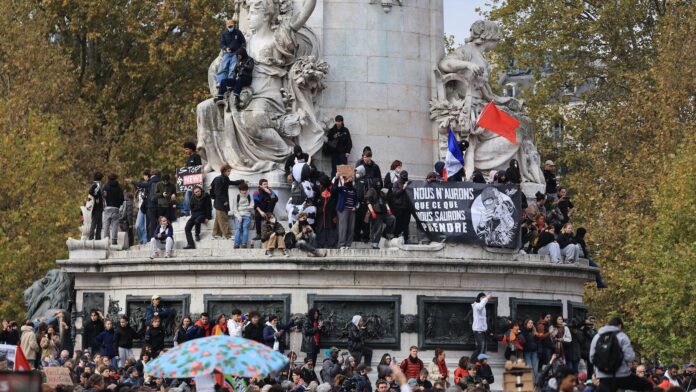
French President Emmanuel Macron confronts his biggest political crisis as more than 700,000 protesters prepare to flood the streets Thursday in a coordinated uprising against rising living costs and years of public spending cuts. Seventy thousand police officers stand ready to control demonstrations spanning 220 cities nationwide, while students, trade unions, and the Yellow Vest movement unite in unprecedented numbers against government policies.
Violence Forces Government Response
Interior Minister Laurent Nunez announced the massive police deployment Wednesday as authorities brace for potential chaos. The demonstrations follow weeks of escalating unrest, including an October 17 incident where French officials admitted police forces completely lost control. Rioters set fire to a high school near Toulouse on Thursday morning as tensions exploded across the country. Authorities implemented localized curfews in multiple cities after vandalism and looting damaged businesses and government buildings throughout October. The Eiffel Tower closed its doors Thursday as strikes paralyzed French rail services, schools, and public institutions.

See what travelers need to know as protests continue:
Student Protests Evolve Into National Movement
What began in September as student-led education reform demonstrations has transformed into a broader rebellion against Macron’s economic policies. The movement gained momentum as frustrated citizens joined forces with established groups like the Yellow Vests, who previously drove massive anti-government protests from 2018 to 2020. CGT union leader Sophie Binet called for workers to expand the strike nationwide, demanding immediate wage increases and a complete revision of the government’s budget proposal. She described the current budget as catastrophic for France’s future. Paris authorities blocked protesters from marching through the city center, instead restricting demonstrators to eastern neighborhoods.
Macron Scrambles With Last-Minute Concessions
Facing mounting pressure, the French government reversed plans to cut 836 public secondary education positions and promised to create 500 new teaching jobs. Education Minister Edouard Geffray announced class sizes will be capped at 28 students in disadvantaged communities starting in 2027. Prime Minister Sebastien Lecornu allocated 4.4 billion dollars for local school renovations. During an October visit to Marseille, where significant looting occurred, Macron acknowledged protesters’ concerns about living costs and students’ futures as legitimate. However, he condemned the violence while protesters accused police of excessive force. The president’s attempts at reconciliation appear insufficient as union leaders push for generalized strikes. Conservative observers note that years of government spending and regulatory policies under Macron’s administration created the economic pressures now fueling widespread discontent across French society.