
Photo: muhammad nadeem / Pexels
By Political Watch Newsroom, Entertainment Desk — Published October 8, 2026
Table of Contents
- Key Takeaways
- The Background & Context
- Why This Matters
- Reactions & Analysis
- What Happens Next
- Frequently Asked Questions
The Mother Road. Main Street of America. The Will Rogers Highway. Route 66 has worn many names, but its route influence American entertainment and pop culture remains unmatched by any other highway in the nation’s history. From Hollywood films to hit television series, from chart-topping songs to streaming documentaries, the legendary two-lane road that once stretched 2,400 miles from Chicago to Santa Monica has become more than asphalt and concrete—it’s become a symbol of freedom, adventure, and the American spirit itself.
Recent recognition of Route 66’s cultural significance came when the historic highway was named Honorary Grand Marshal of the 2026 Illinois State Fair Twilight Parade, according to reports from the Decatur Tribune. The honor underscores how deeply the route remains woven into American identity, even decades after it was officially decommissioned from the U.S. Highway System in 1985.
But why does this particular stretch of pavement continue to captivate our collective imagination? The answer lies in how Route 66 became a character in its own right across multiple entertainment mediums, shaping how Americans see themselves and their country.
Key Takeaways
- Route 66 has been named Honorary Grand Marshal of the 2026 Illinois State Fair Twilight Parade, cementing its ongoing cultural relevance.
- The highway has inspired countless movies, television shows, songs, and books that have shaped American pop culture for generations.
- Route 66 served as a symbol of opportunity, migration, and the American Dream during critical periods of national history.
- The road’s connection to entertainment extends to the celebrities and performers who emerged from communities along its path.
- Modern streaming platforms and contemporary films continue to draw on Route 66 imagery and mythology.
- The highway’s decommissioning in 1985 paradoxically strengthened its mythical status in American culture.
The Background & Context
Route 66 was commissioned in 1926 as part of the original U.S. Highway System. It became operational in 1927, connecting small-town America with urban centers and providing a vital artery for commerce and migration. The road gained particular prominence during the Dust Bowl era of the 1930s when thousands of families fled drought-stricken farms in Oklahoma, Kansas, and Texas, heading west toward California in search of work and survival.
This migration story became immortalized in John Steinbeck’s novel “The Grapes of Wrath,” which was later adapted into a landmark 1940 film. The book called Route 66 “the mother road, the road of flight,” establishing the highway as a powerful literary and cinematic symbol. That single phrase helped transform a federal highway into a metaphor for hope, desperation, and the resilience of ordinary Americans.
The highway’s golden age came in the postwar boom years. As Americans embraced automobile culture and leisure travel, Route 66 became lined with motor courts, diners, gas stations, and roadside attractions. These quirky stops—giant statues, reptile farms, Indian trading posts—became part of the route’s charm and fed into a growing mythology about the American road trip.
The television series “Route 66,” which aired from 1960 to 1964, brought the highway into American living rooms weekly. The show followed two young men driving a Corvette convertible along the highway, having adventures in different towns each episode. Though much of the series was actually filmed elsewhere, it cemented the road’s association with freedom, youth, and possibility in the American imagination.
Music also played a crucial role. Bobby Troup’s “(Get Your Kicks on) Route 66,” first recorded by Nat King Cole in 1946, became a jazz and pop standard. The song name-checks cities along the route—St. Louis, Joplin, Oklahoma City, Amarillo, Gallup, Flagstaff, Winona—turning geography into poetry and making the highway sing.
Why This Matters
Route 66’s influence on pop culture matters because it reflects how Americans understand their own national story. The highway became shorthand for themes that resonate across generations: the promise of reinvention, the lure of the open road, the tension between tradition and progress, and the bittersweet passage of time.
For the entertainment industry, Route 66 provides ready-made narrative possibilities. It’s a linear journey with built-in structure, offering filmmakers and writers a framework for character development and plot progression. Road trips along the route naturally create opportunities for characters to encounter diverse communities, confront personal demons, and experience transformation.
The highway also represents authentic America in an era when much of the country feels homogenized by chain stores and identical suburbs. The surviving stretches of Route 66, with their vintage neon signs and family-owned businesses, offer a tangible connection to mid-century American life. This authenticity has become increasingly valuable as entertainment content seeks to differentiate itself in crowded streaming markets.
The recent honor bestowed by Illinois—naming Route 66 as Honorary Grand Marshal for the 2026 State Fair—demonstrates how states along the route leverage its cultural cachet for tourism and economic development. These communities understand that the highway’s pop culture status translates into real-world benefits: visitor spending, job creation, and preservation funding.
The connection between Route 66 and American celebrity culture runs deeper than many realize. As noted in reporting about Oklahoma’s outsized production of famous performers—from Reba McEntire to Will Rogers—the communities along Route 66 often served as launching pads for entertainment careers. Small-town America, connected to larger cities by this vital artery, could dream bigger because the road literally led to Hollywood.
Reactions & Analysis
The decision to honor Route 66 as Grand Marshal of the Illinois State Fair parade reflects a broader trend of recognizing infrastructure and place as culturally significant entities. Unlike traditional grand marshals—typically celebrities or dignitaries—Route 66 is an abstraction, a collective memory, a shared national experience.
This choice signals that communities along the route see the highway as living history rather than obsolete infrastructure. By personifying the road and giving it ceremonial roles, these communities keep Route 66 relevant for new generations who never experienced it as a functioning highway.
Tourism officials have long understood Route 66’s marketing power. The highway attracts international visitors, particularly from Europe and Asia, who see it as quintessentially American. This global fascination stems largely from pop culture exports—American films, television shows, and music that have spread Route 66 mythology worldwide.
Contemporary entertainment continues to mine Route 66 for content. Pixar’s animated film “Cars” introduced the highway to children through the fictional town of Radiator Springs, a loving tribute to Route 66’s roadside culture. Documentary series on streaming platforms have explored the route’s history, interviewing longtime business owners and preservationists who keep the memory alive.
The highway’s influence extends to advertising and branding. Companies invoke Route 66 imagery to suggest authenticity, adventure, and American heritage. This commercial appropriation sometimes troubles preservationists who worry about the difference between genuine historical appreciation and superficial nostalgia.
What Happens Next
Route 66’s pop culture influence shows no signs of fading. As America grapples with rapid technological change and social upheaval, the highway offers a comforting narrative of simpler times—even if that simplicity is partly mythological.
The 2026 Illinois State Fair parade appearance will likely generate renewed media attention and tourism interest. Such events create opportunities for younger generations to learn about the highway’s history and significance, ensuring cultural continuity.
Preservation efforts along the route continue to gain momentum and funding. As more original Route 66 structures are restored or protected, they become film locations, museum sites, and experiential tourism destinations. This physical preservation reinforces the highway’s presence in popular consciousness.
Streaming platforms and content creators will continue finding new angles on the Route 66 story. Future projects might explore untold perspectives—the experiences of Native American communities, Latino travelers, or African American motorists who faced discrimination at segregated establishments along the route. These more complex narratives can deepen our understanding while maintaining the highway’s cultural relevance.
The road’s symbolic power may actually grow as America becomes more digital and less physically connected. In an age of virtual meetings and remote work, Route 66 represents the opposite: embodied experience, face-to-face encounters, and the irreplaceable value of the journey itself.
Frequently Asked Questions
Why was Route 66 decommissioned if it was so culturally important?
Route 66 was officially removed from the U.S. Highway System in 1985 because the Interstate Highway System had made it obsolete for efficient long-distance travel. The new interstates bypassed small towns in favor of faster, more direct routes. While this decision made practical sense for transportation purposes, it inadvertently enhanced Route 66’s mythological status by transforming it from everyday infrastructure into a nostalgic symbol of a bygone era.
What movies and TV shows have featured Route 66 prominently?
Beyond the 1960s television series “Route 66” and Pixar’s “Cars,” the highway has appeared in numerous films including “The Grapes of Wrath,” “Easy Rider,” and various road trip movies. Documentaries have explored its history extensively. The highway serves as both setting and metaphor in these works, representing freedom, discovery, and the American experience. Music videos, commercials, and streaming content continue to use Route 66 as a visual and thematic element.
How does Route 66 connect to American music history?
Route 66 has been celebrated in American music since 1946 when Bobby Troup wrote “(Get Your Kicks on) Route 66.” Nat King Cole’s recording made it famous, and it has since been covered by countless artists including Chuck Berry, the Rolling Stones, and Depeche Mode. The song’s catchy listing of towns along the route helped cement the highway’s place in popular consciousness. The road also facilitated the spread of musical styles, particularly blues and country music, as musicians traveled between cities along its path.
Can you still drive the original Route 66 today?
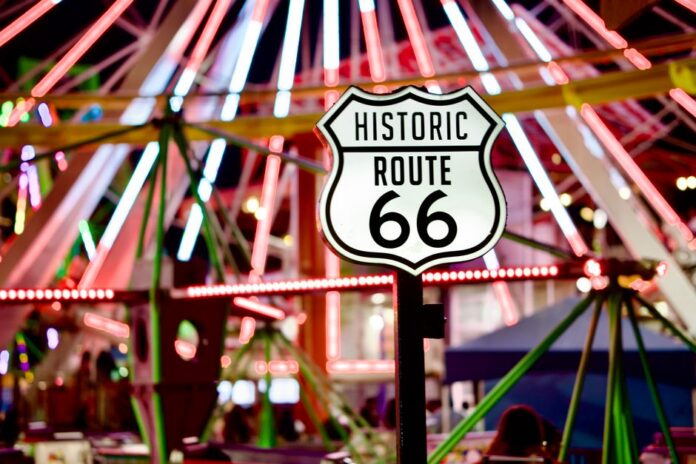
While Route 66 no longer exists as a continuous federal highway, approximately 85 percent of the original route can still be driven using a combination of frontage roads, local highways, and preserved sections. Several states have designated these segments as “Historic Route 66” with special signage. Road trip enthusiasts and tourists regularly travel these remnants, visiting preserved diners, motels, and attractions. This physical accessibility helps maintain the highway’s cultural presence and provides content for travel shows, blogs, and social media, keeping Route 66 alive in contemporary pop culture.
Route 66’s journey from practical infrastructure to cultural icon demonstrates how physical places can transcend their original purpose to become powerful symbols. As the Mother Road prepares for its honorary role in the 2026 Illinois State Fair parade, it continues to remind Americans that some roads lead not just to destinations, but to the heart of who we imagine ourselves to be.