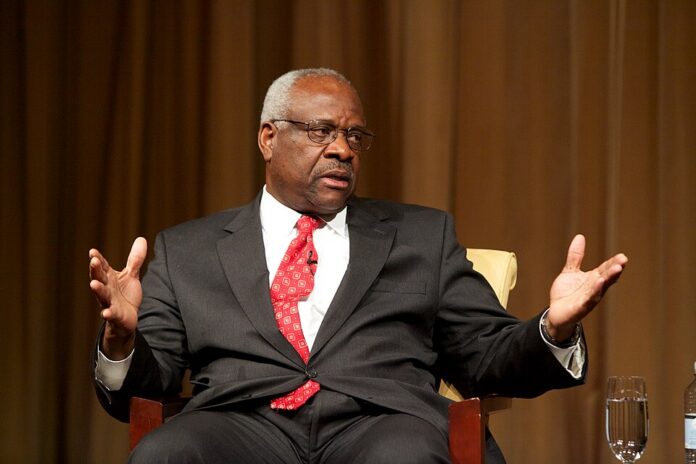
Supreme Court Justice Clarence Thomas pushed back forcefully against critics who have questioned his racial identity because of his conservative political beliefs, declaring the attacks illogical during a recent discussion at the Hoover Institution.
Rejecting Pressure to Conform
Thomas addressed what he described as ongoing attempts to delegitimize his views based on race. During the August 11 conversation with Peter Robinson, the justice grabbed his arm and said the criticism amounts to stupidity. He noted that some critics have even argued that being Black is merely a state of mind, a concept he clearly rejected. The justice emphasized that his physical appearance makes such attacks obviously absurd.
The conservative justice traced his intellectual journey back to his time at Yale Law School, where he first encountered resistance for questioning prevailing assumptions about what Black Americans should believe. Thomas recalled opposing mandatory school busing programs in the 1970s, asking why Black families would want their children transported across town to unfamiliar neighborhoods. His Yale classmates told him he should not hold such views because of his race.
Finding Intellectual Freedom Through Sowell
Thomas credited economist Thomas Sowell, another Black conservative thinker, with helping him develop confidence in his own beliefs. A friend introduced Thomas to Sowell’s book Race and Economics, which the justice described as a drink of water after feeling isolated in his views. The work demonstrated that his instincts could be supported through logical analysis. Thomas later sought out a personal friendship with Sowell, whose example taught him to think independently rather than conform to expectations.
Interestingly, Thomas admitted that as a Yale student in 1972, he initially rejected Sowell’s Black Education: Myths and Tragedies, believing no Black man should think that way. His perspective changed as he continued developing his own understanding of politics and race.
Leadership Versus Popular Opinion
The justice argued that Black political leaders often championed positions that differed from what ordinary Black Americans actually believed. He pointed to debates over school busing and racial preferences as examples where leadership views diverged from community sentiment. Thomas described facing overwhelming pressure for Black Americans to agree with prevailing notions, which he considers almost illusory. He suggested that critics attempt to silence dissenting voices by questioning their racial authenticity, making their arguments irrelevant regardless of merit. For Thomas, the key lesson from Sowell was maintaining intellectual independence while remaining open to being proven wrong through reasoned argument rather than personal attacks.