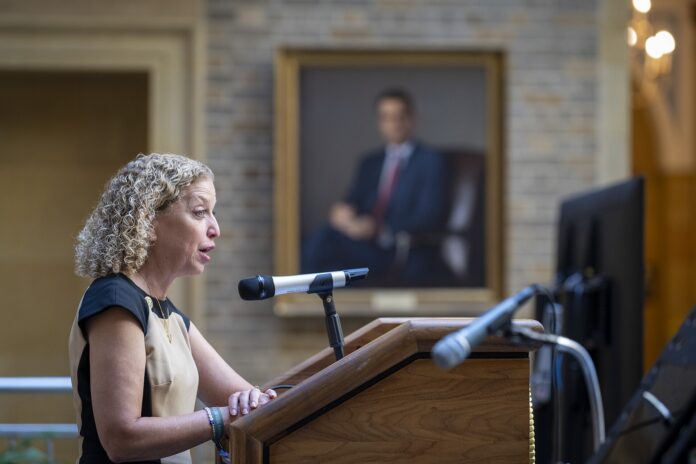
Representative Debbie Wasserman Schultz faces fierce criticism from Black Democratic candidates after choosing to run in a historically Black congressional district following Republican-led redistricting in Florida, raising questions about political representation and the lasting impact of weakened Voting Rights Act protections.
Former Party Chair Crosses District Lines
Wasserman Schultz, 59, is seeking her 12th term by campaigning in Florida’s newly drawn 20th Congressional District, leaving her Fort Lauderdale area seat to compete against four Black candidates in a Broward County district that has elected Black Democrats to Congress since 1992. The district’s voting population is 42 percent Black, 23 percent Hispanic, and 4 percent Asian American, with substantial Caribbean and Haitian American communities. As the former Democratic National Committee chair, Wasserman Schultz holds significant fundraising advantages over her primary opponents in Tuesday’s election, where Florida rules allow plurality wins without requiring a majority.
Former Representative Sheila Cherfilus-McCormick, 47, who resigned in April amid an ethics investigation but now seeks to reclaim the seat, condemned Wasserman Schultz’s decision as an erasure of Black political history. Progressive organizer Elijah Manley, 27, acknowledged that Republican redistricting created the problem but argued Wasserman Schultz could have run in her newly assigned home district instead of competing for Black representation. The Congressional Black Caucus has warned it could lose more than a quarter of its 60-plus members this election cycle.
Supreme Court Ruling Enables Redistricting
The contested race follows the Supreme Court’s decision gutting key Voting Rights Act provisions that previously protected minority voting strength in former Confederate states including Florida. President Donald Trump urged Republican-controlled state legislatures last year to redraw congressional boundaries to preserve the party’s narrow House majority. Governor Ron DeSantis responded by clustering southeast Florida Democrats together, aiming to reduce five Democratic seats to three. Broward County, Florida’s most Democratic county situated between Miami-Dade and Palm Beach counties, now has just one presumed-Democratic district centered around Fort Lauderdale.
Rare White Candidate in Black District
Wasserman Schultz defended her candidacy by citing three decades representing diverse communities as a state and federal legislator throughout Broward County. She rejected accusations of carpetbagging, stating she knows how to serve varied constituencies effectively. If successful, she would become the only white Democrat representing any remaining Black-majority or plurality district nationwide going into November, according to Associated Press analysis. While white lawmakers hold some of the 115-plus House seats with majority non-white voting populations, such arrangements remain uncommon in districts with Black pluralities or majorities, making this primary race a significant test of political representation after redistricting.